

Contents
Key points
- Synthetic data is “information that has been generated to replicate the characteristics of real-world data”, in the words of the 2025 ICC/ESOMAR Code 1.
- In the best-known academic test, a language model reproduced US vote choice with correlations of 0.90 to 0.94 with a real election study, but failed for independent voters 3.
- Other studies found too little variation, wrong effect signs and inflated willingness to pay 4, 5.
- In a 2026 agency test, synthetic data tracked changes correctly only 47% of the time, “essentially no better than a coin toss” 8.
- The ICC/ESOMAR Code requires researchers to tell clients and readers when synthetic data is used 1.
What is synthetic data?
The MRS defines synthetic data as “data that is artificially created to augment or replace real data” 2. In market research the term covers several different things:
- Synthetic respondents or personas: a language model answers a questionnaire “as” a given type of person. The 2025 ICC/ESOMAR Code defines a synthetic persona as a digital representation of a person generated to mimic their behaviours and preferences 1.
- Sample boosting: extra, modelled respondents added to a small subgroup of a real survey, to make it easier to analyse 9.
- Digital twins: an AI model built from one real person’s past answers, used to predict how that person would answer new questions 9.
They promise speed and low cost. Researchers at Harvard Business School note that classic consumer studies generally cost upwards of US$20,000 and take three to six months, while their AI analysis took under 15 minutes 10.
How widely is it used?
In Qualtrics’ 2025 trends study, a vendor survey of 3,198 researchers, 69% said they had used synthetic responses in the past year, and 71% expected the majority of market research to use them within three years 11. In its 2026 edition, 45% of researchers who had adopted synthetic data said it was now their most reliable data source 12.
Supply is concentrated among large agencies: in Greenbook’s GRIT 2026 report, 36% of service-led suppliers with more than 500 staff offered synthetic data or sample, against 8% of those with 20 staff or fewer 13.
What the evidence says about accuracy
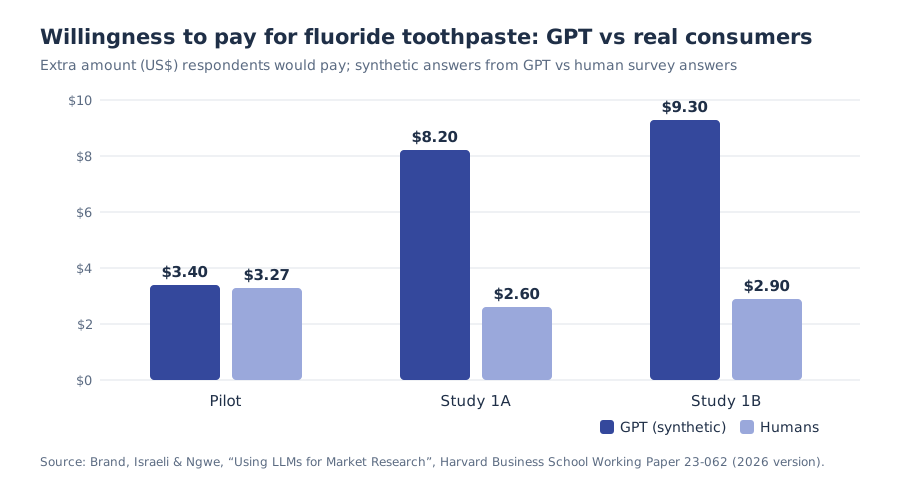
Where it matched. In “Out of One, Many” (2023), Argyle and colleagues gave GPT-3 the backgrounds of real respondents to the American National Election Studies. Its vote choices correlated with the real ones at 0.90 in 2012, 0.92 in 2016 and 0.94 in 2020 3. A first Harvard pilot also found a close match on willingness to pay for fluoride toothpaste: US$3.40 for GPT against US$3.27 for humans 5.
Where it failed. The same election study found a correlation of only 0.02 for pure independents in 2020 3. Bisbee and colleagues (2024) found that averages looked right, but 48% of the coefficients estimated from ChatGPT answers were statistically different from the real ones, the sign of the effect flipped 32% of the time, and there was “less variation in responses than in the real surveys” 4. In the main Harvard studies, GPT’s willingness to pay was US$8.20 and US$9.30, against US$2.60 and US$2.90 for real consumers 5.
Digital twins. A 2026 study of 19 experiments found an average correlation of only 0.20 between twins and the real people they copied, and twins varied less than humans on 154 of 164 outcomes 6. With much richer input (two-hour interviews with 1,052 people), Stanford researchers reached about 85% of the accuracy with which people reproduce their own answers two weeks later 7.
Agency tests. Strat7 compared two synthetic data providers with 3,000 real respondents in 2026: headline results were on average 2 to 3 points away from the real data, but willingness to pay was generally 16% higher, price answers were illogical 68% of the time, and changes over time were right only 47% of the time 8.
Rules: disclosure is mandatory
The 2025 ICC/ESOMAR Code, followed by research associations worldwide, requires that clients be informed when AI or other emerging technologies are used to compile datasets, and that published findings disclose whether AI or synthetic data were used and with how much human oversight 1.
The MRS guidance goes further: synthetic elements must be clearly identifiable when mixed with real data, and practitioners must be able to demonstrate the validity of their insights 2. An MRS council also warns that no widely accepted benchmark exists yet to evaluate synthetic data accuracy, and that synthetic data “will always be retrospective” 14.
When to use it, and when not
- Good uses: generating hypotheses, testing a questionnaire before fieldwork, screening early concepts, and boosting small subgroups when results are validated against real data 14, 8.
- Use with care: keep synthetic answers to a small share of the sample; Strat7 suggests no more than 5% in its 2025 study and 10 to 20% in 2026 15, 8.
- Avoid: tracking studies, new segmentations, key driver analysis, new or niche categories, sensitive topics and final go/no-go decisions 15, 8, 5.
Questions to ask a supplier
- Which part of the results is synthetic, and how is it labelled in the data and the report?
- What real data was the model trained or calibrated on, and how recent is it?
- Have you validated the method against real respondents in my category and market? Can I see the comparison?
- How do you check subgroups and variation, not just averages?
- What would the same study cost and take with real respondents? Compare proposals: you can send one request to up to 5 agencies from any country or city page of this directory.
Frequently asked questions
What is synthetic data in market research?
Data generated by models, usually large language models, to mimic real respondents. It can replace respondents entirely (synthetic personas), add modelled respondents to small subgroups (boosting), or predict how a known person would answer (digital twins).
Is synthetic data accurate?
Sometimes on averages, often not on details. Studies show close matches on some headline measures, but too little variation, wrong effects in subgroups, inflated willingness to pay and poor tracking of change.
Can synthetic respondents replace a survey?
Not on current evidence. Researchers and industry bodies recommend using them to generate hypotheses or test questionnaires, and validating any result against real respondents.
Must agencies disclose synthetic data?
Yes for agencies following the ICC/ESOMAR Code: since 2025, clients must be informed and published findings must say whether synthetic data was used.
Sources
- ICC/ESOMAR International Code (2025 revision)
- MRS, Guidance on using AI and related technologies (2023)
- Argyle et al., Out of One, Many: Using Language Models to Simulate Human Samples, Political Analysis (2023)
- Bisbee et al., Synthetic Replacements for Human Survey Data? The Perils of Large Language Models, Political Analysis (2024)
- Brand, Israeli & Ngwe, Using LLMs for Market Research, Harvard Business School Working Paper 23-062
- Peng, Toubia et al., Digital Twins as Funhouse Mirrors (arXiv, Jan. 2026)
- Stanford HAI, Simulating human behavior with AI agents (policy brief, May 2025)
- Research Live, Synthetic data survey responses significantly different to humans, finds study (Strat7, July 2026)
- Kantar, Synthetic data: the real deal? (vendor article, Aug. 2024)
- Harvard Business School Working Knowledge, Can AI predict whether shoppers would pick Crest over Colgate? (May 2023)
- Research Live, Researchers predict synthetic responses will dominate in coming years (Qualtrics vendor study, Oct. 2024)
- Research Live, Most researchers using AI regularly, finds Qualtrics study (Nov. 2025)
- Greenbook, GRIT 2026 Insights Practice Report
- MRS Advanced Insights & Analytics Council, AI and synthetic data in market research (2025)
- Research Live, Synthetic data lacks logical consistency, finds Strat7 study (July 2025)
 AI in Market Research: What Agencies Actually Use in 2026
 The Fastest-Growing Market Research Markets: Regions and Countries to Watch in 2026
 How Buyers Find a Research Agency in the Age of ChatGPT and AI Search
 ISO 20252:2026: What Changes for Research Buyers and Agencies