
Contents
Key points
- In a Qualtrics survey of more than 3,000 researchers in 14 countries, 53% use AI regularly and nearly nine in ten have experimented with it 1. Qualtrics sells research software.
- In the MRII “AI in Focus 2025” study, 62% of researchers said most or some of their team uses AI, against 39% a year earlier 2.
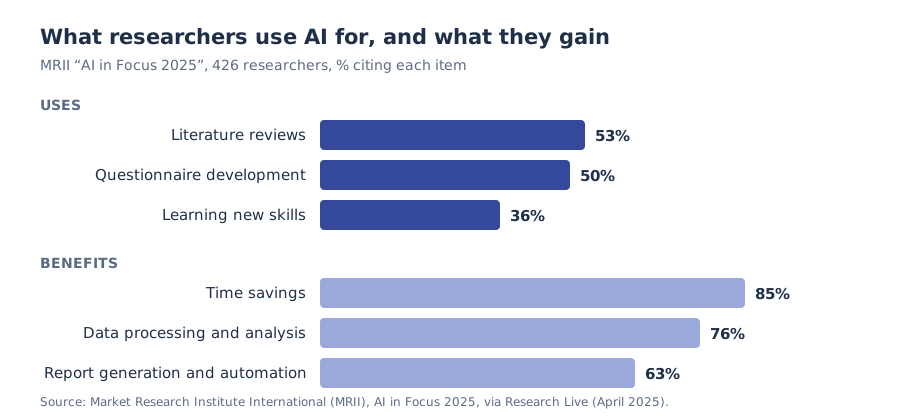
- The most common uses are literature reviews (53%) and questionnaire development (50%); the main benefit cited is time savings (85%) 2.
- AI can help code open answers, but in peer-reviewed tests only a fine-tuned model gave satisfactory results, and human checks are still needed 5.
- AI also creates a new risk: bots that answer online surveys like humans 7. Ask your agency how it detects them.
- Since 2025, the ICC/ESOMAR Code requires researchers to tell clients when AI is used and how much human oversight there is 10.
How widely is AI used?
Adoption has grown fast. Qualtrics’ 2026 Market Research Trends study, based on more than 3,000 market research professionals in 14 countries surveyed in the third quarter of 2025, found that 53% of researchers use AI regularly and nearly nine in ten have experimented with it; 15% are already using AI agents 1. The independent Market Research Institute International (MRII) found that 62% of the 426 researchers it surveyed in February 2025 said most or some of their team uses AI, up from 39% in its previous report 2.
On the supplier side, Greenbook’s 2025 GRIT report found that 67% of suppliers embed generative AI directly into client deliverables, and that 50% of insights professionals are reskilling for AI 3.
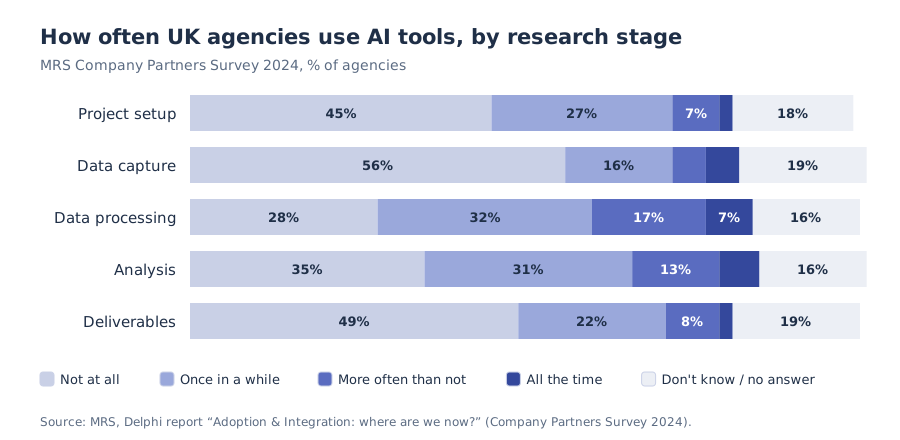
Use is still uneven. In the Market Research Society’s 2024 survey of its UK Company Partners, very few agencies used AI tools “all the time” at any stage; use was highest in data processing and analysis, and lowest in data capture 4.
What agencies actually use AI for
The MRII study gives a clear picture of everyday use: literature reviews (53%), questionnaire development (50%) and learning new skills (36%). Researchers see the main benefits in time savings (85%), more efficient data processing and analysis (76%) and report generation (63%) 2.
- Desk research and questionnaire drafts: the most common uses, and the easiest to check.
- Coding open-ended answers: useful to speed up work on large volumes, with human review (see below).
- Qualitative analysis: in the Qualtrics study, 49% use conversational analytics and 49% use AI to analyse visual content such as video 1.
- AI-moderated interviews: some suppliers run interviews with an AI interviewer; one, Focaldata, reports more than 100,000 interviews in over 30 countries since 2023 4.
- Data quality: agencies such as YouGov list fraud detection and automated data cleaning among their 2026 AI priorities 6.
Where AI still falls short
Coding open answers. A peer-reviewed study in Survey Research Methods found that only a fine-tuned model gave satisfactory results when coding open-ended survey answers: a fine-tuned GPT-4o reached a macro F1 score of 0.87, against 0.71 with a few-shot prompt, and the authors conclude that human involvement is still needed 5. Results depend heavily on the set-up, so ask for an agreement check between AI and human coders on your own data.
Accuracy. The MRS guidance for client-side researchers is blunt: “AI can be wrong, so you should always validate outputs” 8. Summaries and reports drafted by AI need a researcher who knows the data to check every number and quote.
Synthetic respondents. Some suppliers offer AI “personas” instead of real respondents. We cover their promise and limits in a separate article: Synthetic data in market research.
A new risk: AI bots in online surveys
AI does not only help researchers; it can also fake respondents. A study by Sean Westwood of Dartmouth, published in PNAS in November 2025, built an AI agent that evaded detection 99.8% of the time at a cost of about five cents per response, and showed that 10 to 52 fake answers could have changed the predicted result of national polls 7. Online panel providers say their own checks catch such agents, but agree that safeguards are essential 9.
For buyers, this means asking every supplier of online fieldwork how it verifies respondents, which fraud checks it runs and what share of completes it removes.
Rules and disclosure
The ICC/ESOMAR International Code, updated in 2025, requires that the client be informed when AI or other emerging technologies are used, with the extent of human oversight, and that published findings disclose whether AI or synthetic data were used 10. The MRS guidance also says AI use must comply with data protection laws such as the GDPR 8.
In the European Union, the AI Act already applies to prohibited practices and AI literacy since 2 February 2025, and to general-purpose AI models since 2 August 2025; it applies more generally from 2 August 2026 11. Personal data sent to AI tools during a study remains subject to the GDPR.
Questions to ask your research agency
- Which steps of my project use AI, and which tools? Is my data sent to an outside AI provider?
- Who checks the AI outputs, and how? Can you show the agreement rate between AI and human coding?
- How do you detect bots and fraudulent respondents in online samples?
- Will any results come from synthetic respondents rather than real people?
- How does using AI change the timing and the price of the project?
- Compare several answers: you can send one request to up to 5 agencies from any country or city page of this directory.
Frequently asked questions
How many market researchers use AI?
In Qualtrics’ 2026 trends study of more than 3,000 researchers, 53% use AI regularly and nearly nine in ten have experimented with it. In the MRII 2025 study, 62% said most or some of their team uses AI.
What is AI used for in market research?
Mainly literature reviews, questionnaire development, coding open-ended answers, analysing qualitative data and drafting reports. Some suppliers also run AI-moderated interviews and use AI to detect survey fraud.
Can AI replace human researchers?
Not on current evidence. Studies show AI coding still needs human checks, and industry guidance says AI outputs must always be validated.
Must agencies tell clients when they use AI?
Yes for agencies following the ICC/ESOMAR Code: since its 2025 update, clients must be informed when AI is used and how much human oversight there is.
Sources
- Qualtrics, 2026 Market Research Trends (vendor study, Nov. 2025)
- Research Live, Rise in AI use among market researchers (MRII AI in Focus 2025, April 2025)
- Greenbook, The sea change: insights from the 2025 GRIT Business Outlook (June 2025)
- MRS, Delphi report: AI adoption and integration, where are we now?
- von der Heyde et al., coding open-ended survey answers with LLMs, Survey Research Methods 19 (2025)
- Research Live, Preview of 2026: AI (Dec. 2025)
- 404 Media, A researcher made an AI that completely breaks the online surveys scientists rely on (Nov. 2025), on Westwood, PNAS 2025
- MRS Senior Client Council, AI guidance for client-side researchers (July 2025)
- Research Live, The right safeguards can protect public opinion polls from AI pollution (April 2026)
- ICC/ESOMAR International Code on Market, Opinion and Social Research and Data Analytics (2025)
- European Commission, Navigating the AI Act (FAQ)
 The Fastest-Growing Market Research Markets: Regions and Countries to Watch in 2026
 How Buyers Find a Research Agency in the Age of ChatGPT and AI Search
 ISO 20252:2026: What Changes for Research Buyers and Agencies
 Market Research Industry Statistics 2026: Size, Growth and Trends