
Contents
Key points
- 94% of B2B buyers used AI during their buying journey in 2025, according to Forrester 1.
- 45% of B2B buyers have used generative AI, mainly to gather information about suppliers and products, and 69% prefer to check what AI told them with a sales rep (Gartner) 2.
- Google’s AI Overviews reach more than 2 billion users a month 5, and ChatGPT reached 900 million weekly users in February 2026 7.
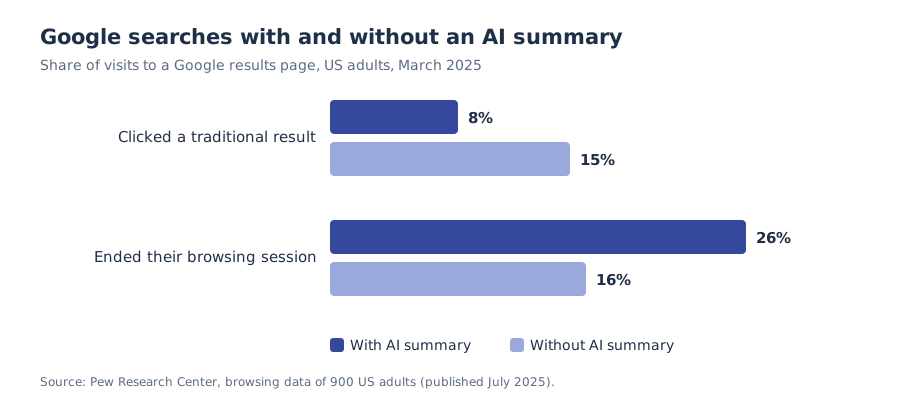
- When an AI summary appears on Google, users click a traditional result on 8% of visits, against 15% without it 8.
- AI search tends to cite third-party sources such as articles, reviews and directories more than companies’ own websites 13.
These studies cover B2B purchases in general, mostly software and services. We found no study specific to market research agencies, but the same buyers, often in marketing and insights teams, are the ones using these tools.
Buyers ask AI first
Forrester’s 2025 Buyers’ Journey Survey found that 94% of business buyers use AI during their purchase, up from 89% a year earlier, and that twice as many buyers as before now name generative AI or conversational search as their most important source of information, ahead of vendor websites and salespeople 1.
Gartner found that 45% of B2B buyers have used generative AI, mainly to gather information about suppliers and products. But trust is limited: 69% prefer to validate AI-generated information with a sales rep, and buyers used seven information sources on average for a recent purchase 2.
Vendor surveys point the same way. In G2’s 2026 survey of software buyers, 51% start their research with an AI chatbot more often than with Google, up from 29% the year before, and 69% chose a different supplier than planned because a chatbot recommended it 3. In 6sense’s 2025 report, the winning vendor was already on the buyer’s list on day one in 95% of cases 4.
Fewer clicks, more answers
AI answers change how people use search engines. Google says AI Overviews have more than 2 billion monthly users in over 200 countries and territories 5; ChatGPT reached 800 million weekly users in October 2025 6 and 900 million in February 2026 7.
A Pew Research Center study of the browsing data of 900 US adults found that when an AI summary appeared, users clicked a traditional search result on 8% of visits, against 15% when there was none; they clicked a link inside the summary on about 1% of visits, and ended their browsing session more often 8.
How AI tools choose which companies to mention
No secret recipe, but visible, consistent information. Google states that there are no additional requirements or special optimisations to appear in AI Overviews or AI Mode: a page must be indexed and eligible for a snippet, and structured data should match the visible text 9. OpenAI says any public website can appear in ChatGPT search unless it blocks OpenAI’s search crawler 10.
Third-party sources weigh heavily. A 2025 University of Toronto study found a “systematic and overwhelming bias” in AI search towards earned media, meaning articles and third-party sites, rather than brands’ own websites: for software in the United States, 72.7% of AI sources were third-party, against 45.4% for Google 13. Google also explains that local prominence depends on information such as how many websites link to a business and how many reviews it has 11.
Facts and sources help. In the academic study that coined “generative engine optimization”, adding citations, statistics and quotations to content gave the largest gains in visibility in AI answers, up to 40%, while keyword stuffing brought little or no improvement 12.
For research buyers: use AI, then check
- Use AI to build a first long list, by country, method or sector, but remember that answers can be incomplete or out of date.
- Check each agency at the source: its website, its directory profile, its methods, references and client reviews.
- Ask about real capacity: who runs the fieldwork, in which languages, with which quality certifications.
- Compare written proposals. AI cannot tell you the price, timing and approach for your brief: you can send one request to up to 5 agencies from any country or city page of this directory.
For research agencies: be easy to find and to verify
- Keep your information consistent on your website, your Google Business Profile and directory profiles: name, city, methods, sectors, contact.
- Collect client reviews. Buyers rely on them and AI tools summarise them 3, 11. On this directory, you can invite your clients to review your agency from your company account.
- Publish facts, not slogans: case studies with figures, sample sizes, countries covered, certifications. Sourced, factual content is what AI tools quote 12.
- Do not block AI search crawlers if you want to appear in AI answers 10.
Frequently asked questions
Do B2B buyers really use ChatGPT to find suppliers?
Yes, increasingly. Forrester found that 94% of B2B buyers used AI during their buying journey in 2025, and Gartner found that 45% have used generative AI, mainly to gather information about suppliers and products.
Can I trust an AI shortlist of research agencies?
Use it as a starting point only. Buyers themselves say AI can be misleading: 69% prefer to validate AI-generated information with a sales rep. Check each agency’s profile, references and reviews, and compare written proposals.
How do AI assistants decide which companies to recommend?
They rely on public web content they can access, including companies’ websites but also, to a large extent, third-party articles, reviews and directories. Consistent, factual information and client reviews make a company easier to find and to recommend.
How can a research agency appear in AI answers?
Keep your information consistent across your website and directory profiles, collect client reviews, publish factual content such as case studies, and do not block AI search crawlers. Google says there is no special optimisation required beyond normal search eligibility.
Sources
- Forrester, B2B buyers make zero-click buying number one (Buyers’ Journey Survey 2025, Jan. 2026)
- Gartner, Survey finds 69% of B2B buyers turn to sales reps to validate AI-generated insights (May 2026)
- G2, The Answer Economy (vendor survey of software buyers, April 2026)
- 6sense, 2025 B2B Buyer Experience Report (vendor report)
- Google, Alphabet Q2 2025 earnings: CEO remarks (July 2025)
- TechCrunch, Sam Altman says ChatGPT has hit 800M weekly active users (Oct. 2025)
- TechCrunch, ChatGPT reaches 900M weekly active users (Feb. 2026)
- Pew Research Center, Google users are less likely to click on links when an AI summary appears (July 2025)
- Google Search Central, AI features and your website
- OpenAI Help Center, Publishers and developers: ChatGPT search
- Google Business Profile Help, How to improve your local ranking on Google
- Aggarwal et al., GEO: Generative Engine Optimization, KDD 2024
- Chen et al., University of Toronto, AI search and earned media (preprint, Sept. 2025)
 AI in Market Research: What Agencies Actually Use in 2026
 The Fastest-Growing Market Research Markets: Regions and Countries to Watch in 2026
 ISO 20252:2026: What Changes for Research Buyers and Agencies
 Market Research Industry Statistics 2026: Size, Growth and Trends